
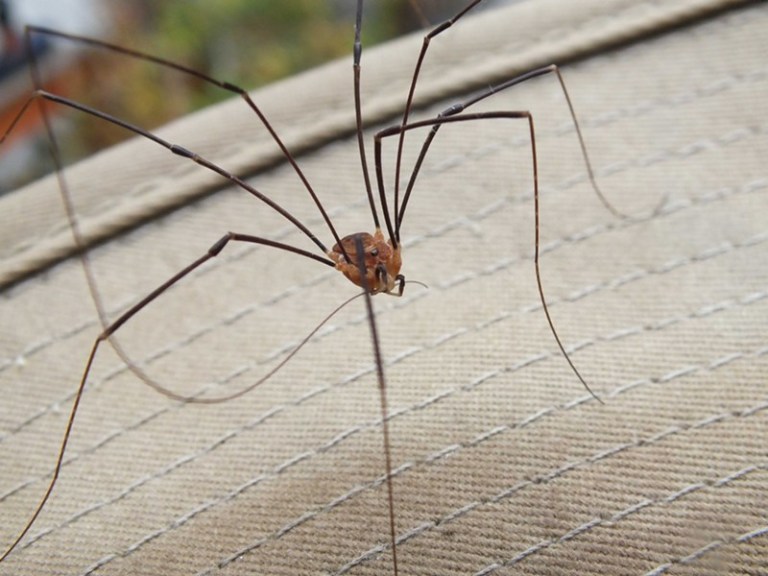
“Daddy long legs” is a common name for three different animals: harvestmen, cellar spiders, and crane flies. Harvestmen are arachnids but not spiders. Cellar spiders are true spiders. Crane flies are six-legged, winged insects. The famous claim that daddy long legs carry the world's strongest venom but cannot bite people is a myth.
So before answering whether a daddy long legs spins a web, has venom, or belongs in the basement, we have to answer the mildly annoying question behind the question: which daddy long legs?
How can you tell the three “daddy long legs” apart?
- Harvestman: eight legs and a body that looks like one compact oval. It does not make silk or have venom glands.
- Cellar spider: eight very long legs, a visibly two-part spider body, and a loose, messy web—often in a basement, crawl space, garage, or ceiling corner.
- Crane fly: six legs, two wings, and antennae. It is an insect, not an arachnid.
The Burke Museum's arachnology reference explains why those three unrelated groups share the nickname and directly addresses the venom myth. The University of Kentucky urban spider chart shows the two-part body and tangled web that distinguish a cellar spider from a harvestman.
Are harvestmen spiders?
No. Harvestmen belong to the arachnid order Opiliones, while true spiders belong to Araneae. They share eight legs and distant arachnid family resemblance, but harvestmen have a broadly fused-looking body, do not produce silk, and do not have spider venom glands.
Harvestmen are often found outside in leaf litter, under logs, or around sheltered vegetation. They may eat small invertebrates and decaying organic material. Calling one a spider is understandable at a glance; calling it proof of a dangerous indoor infestation is not.
Are cellar spiders really spiders?
Yes. Cellar spiders are long-legged web-building spiders in the family Pholcidae. They have the two main body regions of a spider and make loose, irregular webs. The University of Minnesota Extension spider guide describes cellar spiders in dark, secluded building spaces and notes their resemblance to harvestmen.
If the animal is hanging upside down in a messy corner web, you are probably looking at a cellar spider rather than a harvestman. A clear side-on photo that includes the body and web is more useful than leg length alone.
Are daddy long legs poisonous or venomous?
The “most venomous spider” story is false. Harvestmen do not have venom glands. Cellar spiders do have venom used on prey, as true spiders generally do, but the Burke Museum notes that there is nothing exceptional supporting the legendary claim. “Poisonous” would describe harm from touching or eating an organism; “venomous” describes injected venom.
If your real question is about bites, keep that intent separate from general identification. Our daddy long legs bite guide focuses on what is known without recycling the myth into a scarier headline.
Why are daddy long legs in the house?
A cellar spider may find a quiet web site and small insect prey indoors. A harvestman is more likely to have wandered in from outside. Start with the room and the animal: is there a web, is the body one oval or two distinct sections, and are there wings?
For an occasional visitor, careful removal is often enough. For recurring cellar-spider webs, reduce clutter, vacuum old webs and egg sacs, repair screens, seal accessible gaps, and address the small insects they are catching.
The useful takeaway
Daddy long legs is a nickname, not an identification. One body region and no web suggests a harvestman; a two-part body in a messy web suggests a cellar spider; wings and six legs mean crane fly. Browse more Spider identification articles, and if long-legged spiders keep returning throughout a Nashville home, see what Thrive checks during Spider service.
Not sure which long-legged visitor you found?
Save a clear photo that includes the body and any web. If activity keeps returning indoors, see what Thrive checks before recommending service.
